
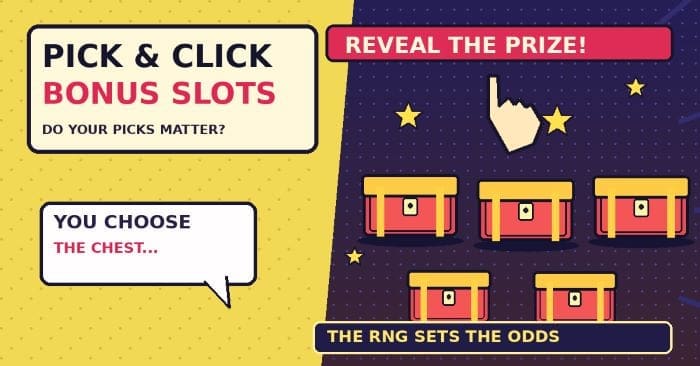
The screen fades to black; the music builds to a crescendo; the reels disappear after twenty minutes of staring at them. twelve chests, perhaps, appear on the screen instead — or twelve eggs, or a deck of face-down cards. A banner pops up telling you to choose Three. Your finger hesitates above the reel. Do you go left, or down the middle? You have a hunch that the middle is the key.
This is why we have Pick and click bonus games. This is why we disassemble them. I have spent many hours playing online slots (and probably far too much time studying pay tables and rule screens). By far the most-often asked question about Pick and click bonus slots is simple: does it actually matter which one you choose? Is it just a magic trick?
The short answer is that in nearly all cases, your choice affects what you see, but not what you win. The long answer is more intriguing because while there are several instances where your choice truly matters, they illustrate quite clearly the creative thinking and engineering of slot machine developers who develop these types of rounds.
What are Pick and click bonus games really?
A Pick and click bonus game is essentially a feature round. Feature rounds are typically initiated through the triggering of Three or more bonus symbols or scatter symbols. Spinning reels give way to a screen full of hidden objects. You select an item at a time to find out what’s beneath. Beneath those objects may be cash prizes, multipliers, additional picks, a free spins award, jackpot tiers, or the collect symbol that terminates the round and locks in the amount accumulated during the round.
The same mechanic is found under a dozen different titles. As such, it is simply referred to as “Pick me,” Pick bonus,” ”Pick a prize,” “choose a chest,” “Pick a door” and “Pick a card.” the artwork varies significantly while the underlying mathematics remains relatively consistent. Players familiar with land-based slot machines will recall wms’s Jackpot Party, in which you clicked on gifts until the party pooper terminated the round. Jackpot Party was instrumental in establishing Pick-me bonus as a common element of slot machine design prior to HTML5 slots putting the mechanism on every mobile device.
Pick and click bonus games generally fall into one of four categories. In a fixed-picks version of the game you receive a fixed number of picks — say Three picks from twelve — and retain whatever you discover. In a Pick-until-collect versions of the game you continue picking until you expose an end-game symbol. A third type of Pick and click game is called a match game; you Pick until you discover Three matching jackpot symbols, and that tier level determines your win. Modern slot games commonly employ a single Pick-screen solely as a chooser; your single click dictates the quantity of free spins you shall receive or the multiplier applied thereto.
Behind-the-scenes workings of Pick and click bonus games
Although the interactive elements represent true code — i.e., your click is registered, and an animation occurs — what ultimately drives the prize determination is the random number generator (RNG) and the game’s math model, essentially the same processes that drive every spin within the base game.
Game developers possess various methods for integrating interactive layers. Therefore, although you cannot visually distinguish among them from an external perspective:
1) Game developers create the entire outcome upon initiation of the bonus game. Upon triggering the bonus, the RNG selects an outcome (e.g., 47 times your bet), and subsequent clicks serve to sequentially unveil slices of that 47x. The prizes do not reside directly behind individual chests at all; they are merely assigned to whichever object(s) you click upon.
2) Prizes are placed behind each object randomly at the onset of the round. Although your selection influences which prize you obtain in a technical sense, since placement is random and you lack knowledge thereof, each chest possesses an equal expectation value. Selecting the center chest provides no greater advantage than selecting a corner chest.
3) For each selection, the RNG generates an entirely new random number. Click, roll, reveal. Just like with outcomes-at-initiation models and pre-shuffle models, in this model as well, your selections have absolutely no bearing upon the ultimate outcome.
As stated previously, regardless of whether using one of the above approaches, your expected return from a bonus round is established via your game’s math model. Thus, regardless of how you interact with this round, your overall expected return is unaltered.
An exception worthy of mention. Many games display the unpicked prizes after conclusion of the round (“see what you missed”). Seeing a 500x hidden below another 10x chest that you selected is very disappointing. Whether that “reveal” represents the actual positioning of prizes on a pre-shuffled board or merely created after the fact to look authentic depends on how the developer implemented this feature. Due to regulatory requirements, regulated games operate pursuant to their documented rules. However, there is no indicator provided anywhere on the screen to enable verification of which methodology any particular game employs. Consequently, I would categorically view “missed-prize reveals” as decorative rather than indicative.
What happens before you select?
Illustration of how this works is easiest when demonstrated with a hypothetical example. Let us assume a Pick bonus slot game employing nine chests and providing you Three picks. Underneath each chest lies: five x your bet, five x your bet, ten x your bet, ten x your bet, fifteen x your bet, twenty x your bet, twenty-five x your bet, fifty x your bet, and 100 x your bet. The aggregate sum equals 240 x your bet. Consequently, each chest has an average value of approximately 26.7 x your bet. With three picks available to you, your expected value is therefore 80 x your bet.
You may opt to select all three chests located along the top row; all three chests located diagonally; or select the three chests that reflect your personal preference. Regardless of which combination you select, your expected value remains constant at 80 x your bet because in the absence of any relevant information, none of the chests differ from one another.
Your actual result will vary considerably however. If you hit both five x bets, you will realize fifteen x; whereas if you hit the 100x, 50x, and 25x bets respectively, you will realize 175x. This variability represents randomness or variance. The average itself remains unchanged.
Thus, as explained above, a theoretical RTP is calculated for all aspects of a game, including base game and bonus features. While studios frequently engineer their Pick rounds to contribute substantially to this theoretical RTP (hence why they seem so significant when they occur), this contribution is an inherent characteristic of the game’s math model — established prior to launch and tested by independent laboratories such as GLI, iTech Labs or eCOGRA — dependent on certification required by applicable jurisdictions. Your method of picking does not affect it.
Therefore, are Pick bonuses truly random? Yes, certainly in terms of your bankroll. Are Pick and click bonuses predetermined? Sometimes literally; sometimes only de facto. Ultimately, regardless of which approach employed, the rng governs everything.
Do your Pick speed or Pick order matter?
Many people ask about this issue. I understand why they do. When faced with a matrix consisting of twelve identically sized boxes — each containing its own mystery — you search for any competitive advantage whatsoever. Some players consistently begin in a corner location. Other players believe that clicking rapidly on each successive box somehow confuses the system; or alternatively that pausing momentarily allows sufficient time for the ‘correct’ prizes to stabilize.
Neither supposition holds water. In models utilizing outcome-determined-by-triggers — i.e., all values determined upon initial triggering — regardless of how quickly or slowly you click — the outcome existed prior to loading of the screen, thereby rendering speed and/or order irrelevant. Likewise in models employing pre-randomized arrays — i.e., randomized arrays existing at onset of round — only relevance arises should you possess knowledge regarding placement of prizes — which you do not. In models generating a new RNG value per click — i.e., certified RNGs cycle independently and randomly far faster than any human input — no human can possibly time his/her clicks accurately enough to align with an RNG value.
Is picking the first chest more advantageous in Pick bonuses?
Picking first provides some slight benefit in that it represents the first item revealed. Picking first does not provide any greater value than picking last. Corner-box habits developed by some players are primarily based on recollections of one occasion when a corner produced large returns — which becomes stored in memory for later reference. That creates an opportunity for Psychologists to enter into discussion.

Skill vs luck & illusion of control
Ellen langer coined this term: “illusion of control.” It refers to feelings experienced by players resulting from making a conscious selection from among multiple possibilities — in this case selecting a chest from numerous others — whereby players perceive their selection as having direct impact upon outcome. Langer conducted studies in the early seventies demonstrating that individuals perceived tickets purchased by themselves in a lottery more favorably than those received freely despite being statistically equivalent in probability.
Choice produces perception of involvement; involvement produces perception of influence.
A primary objective when designing a Pick-and-click round is to create this perception of control. The base game utilizes only “press-spin,” whereas in this round you make decisions — or at least simulate decisions.
When good things happen post-reveal, some portion of you attributes success to your choice. Conversely, when poor things happen post-reveal, you attribute failure to bad luck — or attribute failure to poor decision-making relative to alternatives (left).
Either reaction increases perceptions that selections represented more than mere chance.
Can skills utilized in games lead to better results?
Almost never. A Skill-based game represents one wherein better decisions generate superior results over time, thus allowing skilled players to outperform inferior players — on average. Were a mathematician and child positioned side-by-side in front of a typical Pick bonus game; both would achieve virtually identical averages.
Since neither player possesses information regarding optimal/least-optimal combinations; both will experience similar levels of variance — as defined above.
Skill-based games require superior decision-making leading to better performance — over time — and superior players beating inferior ones — over time. Since no information is provided regarding optimal/least-optimal combinations; superior decision-making does not exist in this context — and henceforth there is no Skill involved.
Consequently, while not inherently deceptive; Pick and click bonus rounds encourage players to utilize their selections strategically; as opposed to recognizing that selections are merely random events.
Why do these types of games create such illusions?
While calling these rounds “slot-bonus-game Theater” may seem pejorative; it is apt in describing exactly what they accomplish creatively: creating an entertaining experience for players.
Creative design efforts are expended on developing compelling user experiences through development of these types of rounds. Wherever possible; studios focus attention on ensuring that emotional peaks are achieved within sessions through design.
Note how pace is designed throughout successful iterations of these rounds. Reveal animations are deliberately slower than necessary. Smaller prizes elicit smaller celebratory sounds; larger multipliers elicit louder celebratory sounds. Often an accumulation bar displays an increasing total as prizes accumulate atop it; thus giving players an increased sense-of-progress during progression through their bonus round. Additional picks are viewed positively by players even though their value is already embedded within the mathematical model governing gameplay. Finally; celebrate screens displaying totals are displayed immediately following collection symbols terminate rounds — regardless of magnitude.
These are examples of anticipation mechanisms: suspense; delay; escalation. Additionally, players also recognize “near-miss” effects exhibited within “Pick-until-match” jackpot games; where players witness two major jackpots followed by two minor jackpots and ultimately conclude with discovering a low-tier prize. At that point; players felt they were “just one away” from achieving major status; and that sensation lingers with them for much longer than does their eventual small-win.
Frequently Asked Questions
What are Pick-and-click bonus games?
Pick-and-click bonus games are slot bonus rounds wherein players select concealed objects such as chests, cards or doors in hopes of revealing prizes such as cash amounts, multipliers, additional picks or free spins awards. Rounds typically conclude upon depletion of available picks or exposure of collect/end-round symbols.
Are Pick-and-click bonuses Skill-based?
In nearly all cases, no. As stated earlier, RNGs and mathematical models driving games dictate outcomes — and consequently each conceivable selection yields identical expected values. Exceptions include features possessing tangible decision-making capabilities such as volatility selection; gamble option acceptance/rejection opportunities etc.
Are Pick-and-click bonuses truly random/predetermined?
Yes — depending upon construction methodologies employed by studios. Certain implementations establish outcomes prior to initiating bonus rounds and subsequently present selections which correspondingly disclose previously-established outcomes upon player interaction (i.e., clicking). Other implementations employ randomization techniques; shuffling prizes randomly behind objects upon commencing rounds; rolling RNGs per-click etc.. In any event; player selections do not enhance expected outcomes.
Does order/speed matter regarding picks?
No — regardless of whether certified RNGs cycle independently/randomly sufficiently rapidly for humans to control timing or whether speed/order potentially correlates with temporal factors influencing RNG outputs; certified RNGs cannot be controlled by humans — regardless of attempt or intent.
Are picking first chests more advantageous than picking last chests in Pick-bonuses?
No — except for the fact that first-picked chests represent first-revealed items; first-picked chests do not hold greater value than last-picked chests. Corner-chest habits formed by certain players are largely based on recollection(s) of occasions when corner locations yielded substantial rewards — subsequently becoming embedded in memory for future reference.